Hydraulic cylinders are responsible for lifting, pushing, pulling, and positioning heavy loads across countless applications. But what happens when a machine needs more than just movement? What if it needs to know exactly where a cylinder is during operation?
That’s where smart hydraulic cylinders come in.
By incorporating position sensors and electronic feedback into traditional hydraulic cylinder designs, smart cylinders allow operators and automated systems to monitor cylinder movement with greater accuracy and control.
What Is a Smart Hydraulic Cylinder?
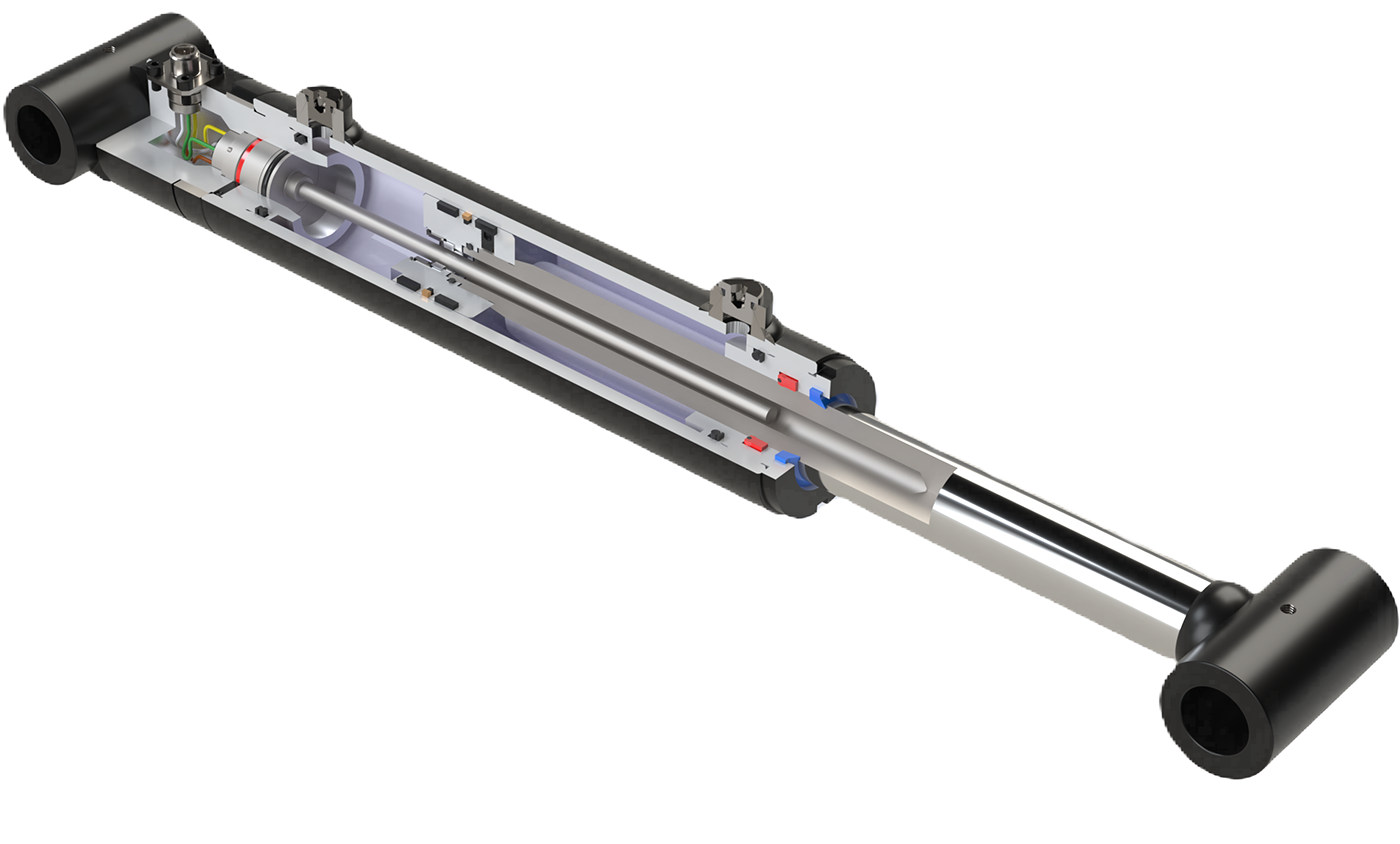
A smart hydraulic cylinder is a hydraulic cylinder equipped with sensors that provide information about its movement or position.
A traditional hydraulic cylinder uses pressurized fluid to extend and retract a piston rod, generating linear force. While this is effective for many applications, the cylinder itself doesn’t provide information about how far the rod has extended or where it is within its stroke.
Smart cylinders add that capability through position-sensing technology.
Depending on the design, sensors can be installed internally, externally, or embedded into the cylinder assembly. These sensors send electrical signals to a machine’s control system, allowing it to monitor the cylinder’s position and respond accordingly.
This makes smart hydraulic cylinders especially useful in equipment that requires precise positioning, repeatable movement, or automated operation.
How Do Smart Hydraulic Cylinders Work?
The basic hydraulic operation remains the same. Pressurized fluid enters the cylinder, moving the piston and extending or retracting the rod.
The difference is how that movement is monitored.
A smart cylinder uses a sensor to detect the piston’s position as it moves through the cylinder. That information is converted into an electrical signal and sent to a connected controller, such as a programmable logic controller (PLC).
The controller can then use that information to monitor movement, verify positioning, or make adjustments through the hydraulic control system.
For example, consider a hydraulic press that needs to stop at a specific position during every cycle. Rather than relying only on a preset movement time, a smart cylinder can provide position feedback to help the control system determine when the desired position has been reached.
This process is known as closed-loop position control when the feedback is used to continuously compare actual movement against the commanded position and make corrections.
Not every smart cylinder requires closed-loop control, but position feedback gives equipment designers more options for monitoring and automation.
Types of Smart Cylinder Position Sensors
Not every application requires the same level of position feedback. Some machines need continuous measurements throughout the cylinder’s stroke, while others only need confirmation that a certain position has been reached.
Yates Industries offers smart cylinder options that can incorporate several types of sensing technology.
Linear Displacement Transducers (LDTs)
Linear Displacement Transducers, commonly called LDTs, measure the position of a cylinder’s piston throughout its stroke.
Many hydraulic cylinder LDTs use magneto strictive technology. A magnet attached to the piston moves along a sensing element as the cylinder extends or retracts. The sensor detects the magnet’s location and converts that measurement into an electrical position signal.
Because magneto strictive sensing does not require sliding contact between the magnet and sensing element, it is well suited for applications requiring continuous position feedback.
LDTs are commonly used in industrial machinery where accurate, repeatable positioning is important.
Linear Resistive Transducers (LRTs)
Linear Resistive Transducers, or LRTs, are another option for measuring cylinder position.
Unlike non-contact magneto strictive LDTs, LRTs typically use a resistive element and moving contact to measure displacement. As the piston moves, the electrical output changes in proportion to its position.
LRTs can provide a cost-effective solution for applications that need continuous position monitoring but do not require the same sensing technology as an LDT.
The right choice depends on the application’s accuracy requirements, operating conditions, and budget.
Limit Switches and Reed Switches
Not every machine needs to track a cylinder’s position throughout its entire stroke.
In some applications, it is enough to know when the cylinder has reached a particular point.
Limit switches and reed switches provide this type of position detection. Rather than continuously measuring displacement, they signal when a specified position or condition has been reached.
For example, a machine may need confirmation that a hydraulic cylinder is fully extended before beginning the next step in its operating sequence.
These switches can provide that confirmation without requiring a continuous position measurement system.
Internal vs. External Cylinder Position Sensors
Smart hydraulic cylinder sensors can be incorporated into a cylinder in different ways depending on the equipment’s requirements.
Internal sensors are installed within the cylinder assembly. This can protect sensing components from external exposure and provide a compact design. Certain internal sensor arrangements require modifications to the piston rod or other cylinder components.
External sensors are mounted outside the cylinder and monitor movement using a compatible sensing arrangement. Depending on the design, external sensors may offer easier access for maintenance or replacement.
The choice between internal and external sensing depends on available space, environmental conditions, maintenance needs, and the required level of position feedback.
What Are the Benefits of Smart Hydraulic Cylinders?
Smart cylinders aren’t necessary for every hydraulic application. However, when equipment depends on accurate movement or automated processes, position feedback can provide several advantages.
Improved Positioning Accuracy
Position sensors allow a control system to monitor where the piston is during operation. When paired with the appropriate hydraulic controls, this information can help equipment achieve more accurate positioning.
Greater Control Over Automated Processes
In automated equipment, one movement often needs to be completed before another can begin.
Smart cylinders provide position information that controllers can use to coordinate these movements and verify that the cylinder has reached its intended position.
More Consistent, Repeatable Movement
Applications involving repeated cycles often require a cylinder to return to the same position each time.
Position feedback allows a machine’s control system to verify movement and make corrections when supported by the hydraulic system.
Better Visibility into Cylinder Operation
Traditional hydraulic cylinders may require external equipment or manual observation to determine their position.
With integrated sensing, position information becomes available directly to the machine’s control system. This can assist with troubleshooting, process monitoring, and identifying unexpected movement.
Where Are Smart Hydraulic Cylinders Used?
Smart hydraulic cylinders are used in industrial applications where knowing the cylinder’s position is important to the machine’s operation.
Common applications include:
- Hydraulic presses: Monitoring ram position during forming, stamping, and pressing operations.
- Manufacturing automation: Coordinating cylinder movement with other equipment during production.
- Material handling equipment: Controlling lifting, positioning, and transfer operations.
- Steel mills and heavy industrial machinery: Providing position feedback in demanding production environments.
- Mobile hydraulic equipment: Monitoring cylinder extension and retraction in equipment that requires controlled movement.
While a standard hydraulic cylinder may be sufficient for simple extend-and-retract operations, smart cylinders are useful when the equipment requires more information about what is happening during each movement.
Smart Hydraulic Cylinder Solutions from Yates Industries
At Yates Industries, we understand that not every hydraulic application has the same requirements.
Some equipment needs a straightforward hydraulic cylinder built to withstand heavy use. Other applications require specialized features, position feedback, or compatibility with automated control systems.
Our smart cylinder capabilities include options for LDT and LRT position sensing, along with internal and external sensing arrangements and switch-based position detection.
With in-house engineering and cylinder manufacturing capabilities, Yates can help customers determine which features make sense for their equipment and application.
Whether you’re looking for a new hydraulic cylinder with position feedback or exploring options for a specialized cylinder design, our team can help you find the right solution.
Have questions about smart hydraulic cylinders? Contact Yates Industries at (586) 778-7680 or visit www.yatesind.com to learn more about our hydraulic cylinder manufacturing capabilities.
Related Blogs
- How to Measure for a Replacement Hydraulic Cylinder
- Custom Hydraulic Cylinders: How to Customize a Cylinder for Your Application
- Double-Acting vs. Single-Acting Hydraulic Cylinders: What’s the Difference?