We’re available to handle your mill duty cylinder repair 24 hours a day, 365 days a year.
Our repair facility is the largest and most comprehensive in the Midwest, offering 24/7 emergency service along with convenient pick-up and delivery options. Yates maintains an extensive inventory of components and materials to ensure your cylinder can be repaired quickly, even under tight deadlines. With decades of experience, we can repair and recondition virtually any make or model of hydraulic cylinder, including both standard and metric designs.



Routine inspections, proper lubrication, seal monitoring, fluid cleanliness, and preventative maintenance programs can help extend cylinder life and reduce the risk of unexpected failures.
Common replacement components may include seals, bearings, wear bands, rods, pistons, bushings, mounting hardware, and other internal hydraulic components depending on the condition of the cylinder.
Yes. In addition to repair services, Yates Industries can manufacture replacement hydraulic cylinders designed to meet OEM specifications or custom application requirements.
After repairs are completed, cylinders may undergo pressure testing, leak testing, dimensional inspections, and operational testing to verify proper performance and reliability before returning to service.
Mill duty cylinders are engineered for demanding environments and applications where they are exposed to heavy loads, continuous operation, and high pressures. Industries they are found in include steel mills, material handling, mining, and more.
Unlike standard hydraulic cylinders, mill duty cylinders are designed with thicker barrel rods, oversized rods, reinforced mounts, and heavy-duty sealing systems. Their rugged construction helps them withstand shock loading, vibration, contamination, and extreme temperatures, while minimizing the risk of premature failure.
Many mill duty cylinders are custom designed to fit specific equipment and operating conditions, and they often require precision engineering and specialized manufacturing processes to meet their application requirements.
Due to their rugged design and occasional custom requirements, mill duty cylinders require specialized machining, experience, and equipment. A successful and thorough mill duty cylinder repair involves more than simply changing seals or damaged parts.
Technicians must thoroughly inspect every component, evaluate tolerances, identify the root cause of failure, and restore the cylinder to OEM specifications. In many cases, repairs may involve precision machining, welding, chrome repair, straightening, or custom component fabrication.
Due to their frequent exposure to intense cycling and stress, mill duty cylinders require routine inspections and preventative maintenance. Mill duty cylinders often show warning signs before complete failure occurs, such as:
Hydraulic leaks are one of the most common indicators that a mill duty cylinder requires repair. Leaks may develop from worn seals, damaged rods, cracked welds, or excessive internal pressure buildup. Common causes include:
Cylinder rods and internal surfaces can become damaged from contamination, impact, improper lubrication, or long-term wear. Surface damage can quickly lead to seal failure and internal scoring. Watch for:
Performance issues often indicate internal wear or hydraulic inefficiencies within the cylinder assembly. Cylinders may struggle to maintain pressure, move consistently, or hold loads properly. Warning signs include:
Abnormal sounds or vibration during operation may signal internal component damage, contamination, or structural issues within the cylinder. Examine your equipment for these warning signs:
Every mill duty cylinder repair begins with a detailed inspection and failure analysis process. Our technicians examine the cylinder’s overall condition, identify damaged components, and determine the root cause of failure.
Once this inspection is complete, the cylinder is fully disassembled and cleaned to remove any traces of debris, contamination, and hydraulic residue. Thorough cleaning ensures that all internal and external components are properly evaluated for wear, cracking, corrosion, or structural damage before repair begins.
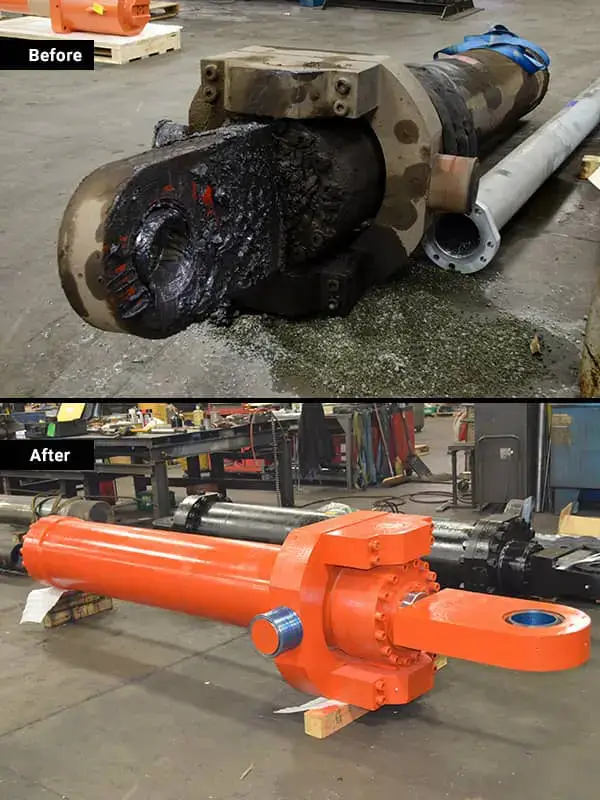
Damaged components are repaired or restored using precision machining and specialized repair processes. Depending on the cylinders’ condition, repairs may include rod rechroming, barrel honing, welding, straightening, machining, etc. Our priority is to restore proper tolerances, performance, and extend your equipment's service life.
After repairs are completed, the cylinder is carefully reassembled using high-quality seals and components. Proper assembly procedures and torque verification are critical to ensuring long-term reliability and maintaining OEM performance standards in severe-duty operating conditions.
As an integral part of our rigid quality process, all mill duty cylinder repairs and mill duty cylinder rebuilds are tested to their rated pressures before exiting our shop floor. With test stands rated for 10,000 PSI and fixtures for unique applications including water service, steel mills and marine, you can be assured your component is ready for use when you receive it. We then work closely with our customers to implement processes to help prevent costly breakdowns from reoccurring.
Determining whether to repair or replace your mill duty cylinder depends on several factors, including the extent of the damage and your long-term operational goals. In many cases, repairing a cylinder provides saved costs and faster turnaround times than sourcing an entirely new unit.
Our experienced team will evaluate the condition of your cylinder and recommend the most practical option based on performance requirements, downtime considerations, and equipment demands.
Repair is often the preferred solution when the cylinder core structure remains in good condition, and damaged components can be restored or replaced efficiently. Specialized repairs can significantly extend service life while minimizing downtime and replacement costs.
In some situations, extensive structural damage or repeated failures may make replacement more practical than continued repair. Severe corrosion, cracked barrels, or outdated cylinder designs can impact long-term reliability and performance.
Choosing between repair and replacement requires evaluating operational costs, downtime, lead times, and equipment performance requirements. A proper assessment helps determine the best long-term solution for maintaining productivity and reliability.
Hydraulic cylinder failure can sneak up on you. At Yates, we prioritize fast response times and reliable repair support when emergency breakdowns occur. Our repair teams work efficiently to minimize downtime that harms your operation. Our capabilities include:
Unexpected failures can occur at any hour, especially in facilities that operate around the clock. Our emergency repair services are available 24 hours a day, 365 days a year to support critical equipment and reduce production interruptions. Call our 24/7 emergency hotline at (800) 340-6024.
Downtime is expensive. With in-house machining, emergency repair, and testing capabilities, we can streamline the repair process and avoid unnecessary delays.
To help simplify the process, we offer both coordinated pickup and delivery support.
With repair facilities in Michigan, Alabama, and Ohio, Yates can distribute workload efficiently and service customers throughout the nation.
Choosing the right repair partner is just as important as choosing the right cylinder. At Yates, we combine decades of hydraulic cylinder repair experience with in-house machining capabilities that provide dependable solutions. Some of our benefits include:
Yates is proud to be a leading manufacturer and rebuilder of hydraulic and pneumatic cylinders. With decades of experience, our team has worked on a wide range of mill duty cylinder designs, applications, and failure conditions.
All major repair operations are completed in-house, allowing us to maintain quality control and deliver faster turnaround times. Our machining capabilities support rod repair, barrel honing, thread restoration, and more.
Every cylinder repair is completed with close attention to OEM specifications. Throughout the repair process, up to final inspection, our goal is to restore each cylinder to meet—or exceed—its original performance.
Consult with our team for warranty details.