5 Signs Your Hydraulic Cylinder Needs Immediate Repair
Hydraulic cylinder failure is costly, but can be prevented through routine inspections. Learn more about which signs to look out for during these inspections.
Hydraulic cylinder failure is costly, but can be prevented through routine inspections. Learn more about which signs to look out for during these inspections.
Hydraulic cylinder failure is costly, disruptive, and potentially dangerous. Fortunately, it can almost always be avoided. The key is to carry out regular inspections and address any problems quickly. Most major faults can be avoided when problems are caught early. Additionally, repair or replacement work can often be scheduled for a time that minimizes disruption to regular operations.
When you’re performing your routine inspections, look out for these signs of trouble:

Leaks anywhere in the circuit, including at cylinder ports or around the ram itself, reduce the pressure applied to the piston, which in turn reduces the force the cylinder can apply and slows its operation. Leaks around the rod indicate a damaged seal. Note that the seal is inside the cylinder barrel and is not the wiper that’s visible from outside the cylinder.
When you notice leaks, also check if the fluid is contaminated either by solid particles or by water.
Solid particles will wear the inner surface of the barrel and the rod itself. If the fluid isn’t changed, particles can damage seals and the internal wear bands. They may also restrict port operation.
Water contamination affects both viscosity and system efficiency. It may cause corrosion and pitting of internal surfaces, and could potentially change to vapor, dramatically affecting system operation.
You can avoid contamination by changing fluid at the OEM-recommended intervals and using appropriate filters in the system. Wiper maintenance and replacement can also help prevent contamination.

Even though cylinders are chrome-plated, the rod at the heart of the cylinder can become worn. This wear can look like long, thin, axial scratches in random places around the rod, or more general regions of wear along one side.
Linear scratches indicate particles in the fluid and/or wear bands, which will lead to fluid leaks and should be addressed promptly.
A more generalized wear region on one side suggests the rod is misaligned or subjected to side loading. This would cause it to press harder against the wear bands on one side, and if especially severe, the rod end cap. This will quickly lead to fluid leaks and increased energy consumption. If not addressed, it could result in the rod bending or sticking, which can damage the equipment and become dangerous.
Resolving uneven wear like this involves inspecting the cylinder’s installation to identify and remove any side loading.
A cylinder that won’t move despite the application of fluid pressure is clearly in need of repair. In such a situation, the equipment it’s used on will be inoperable, and the repair will most likely be urgent.
Possible causes are port blockage, a bent rod, or seizure due to thermal expansion. Rather than applying high forces to make it move, the correct repair strategy is to remove and disassemble the cylinder to determine the precise failure mode.
Once complete, the cylinder can be repaired or, if the damage is too severe, replaced.
These signs have two possible causes. Either there is excessive pressure within the cylinder, leading to structural deformation, or the rod is so misaligned that the piston is pushing hard against one side of the barrel.
In the best case, fluid will leak past the piston and rod seals. In the worst case, the barrel will rupture, releasing pressurized hydraulic fluid in an uncontrolled and dangerous manner.
If a visual inspection reveals any barrel deformation, the equipment using the cylinder should be taken out of service immediately. The cylinder should then be removed for disassembly and further inspection. In most cases, the cylinder will need to be replaced, although a specialist can advise on options for rebuilding with a new barrel.
A hydraulic cylinder that’s in good condition should operate with almost no noise, so any new sounds, such as squealing, knocking, or banging, should be noted.
Squealing sounds suggest rubbing or friction that increases loads on the system and accelerates wear rates. They could also indicate a worn seal or damaged wear band. If attended to promptly, these repairs are usually straightforward. On the more serious side, squealing can indicate some misalignment or the impact of side loads, which should be dealt with quickly.
Knocking and banging usually result from cavitation—localized fluid pressure drops that cause voids—or aeration, when air becomes entrained in the fluid. Both cavitation and aeration are usually caused by fluid faults; either the fluid level is too low or it has become contaminated. If inspection shows the fluid level is correct, the system should be flushed and the fluid replaced.
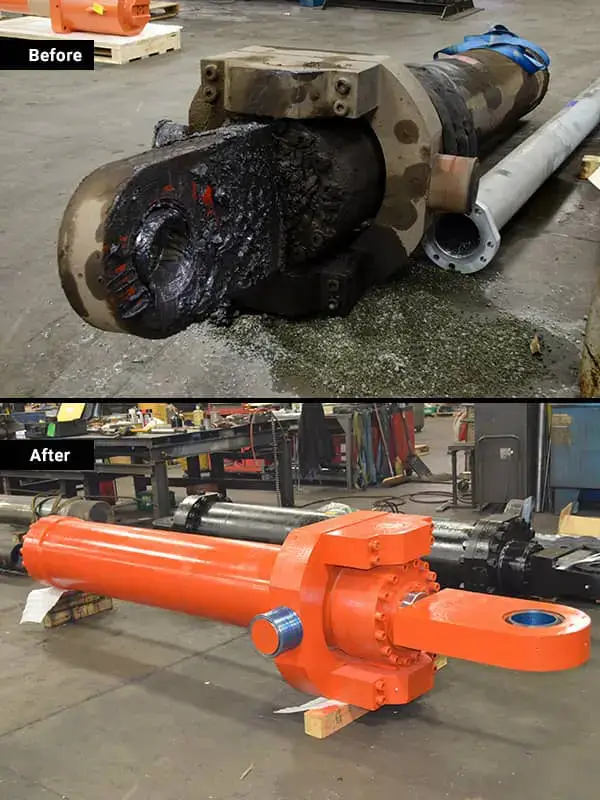
Some repairs, like seal replacements, are easy to do yourself, but most often, you’ll need help from an experienced technician, especially if you’re not sure of the cause of your cylinder’s issues.
If you’ve noticed a decline in your cylinder’s performance, or any of the signs listed in this article, turn to Yates Cylinders. We’re a U.S.-based manufacturer offering standard and emergency repair solutions for businesses across the United States, and have four locations with in-house repair capabilities for tie rod, welded, mill-duty, hydraulic, and pneumatic cylinders.
Call (800) 340-6024 now if you’re dealing with an emergency, or complete our online form to schedule an inspection for a non-emergency issue.