Is It Time to Upgrade to a Heavy-Duty Hydraulic Cylinder?
Overloading hydraulic cylinders can have devastating consequences. Learn when it’s time to upgrade to a heavier-duty model.
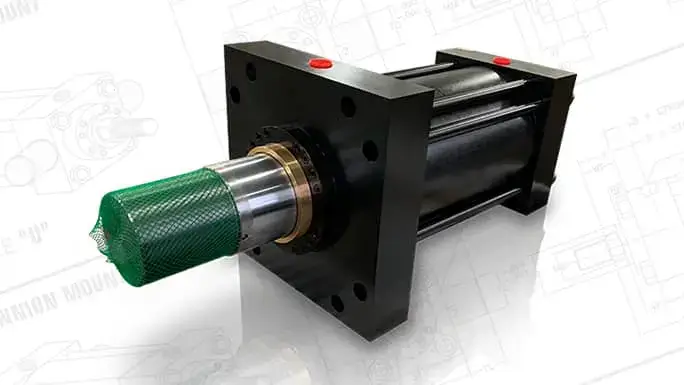
Overloading hydraulic cylinders can have devastating consequences. Learn when it’s time to upgrade to a heavier-duty model.
Overloading hydraulic cylinders is a significant mistake that can have devastating consequences: rods and mounting brackets can fail with little or no warning, cylinders can rupture, and sudden, uncontrolled motion can cause machinery to tip or hydraulic fluid to spray.
Preventing problems like these means designing equipment for worst-case scenarios. The challenge is that it’s difficult to anticipate every possible use case. Additionally, when OEMs balance performance and cost, designs may be adjusted in ways that, in some applications, push cylinders to their limits.
If your hydraulic equipment is continuously being overloaded, you’ve probably already noticed some warning signs. However, as a general rule of thumb, we recommend upgrading to a heavy-duty hydraulic cylinder when you’ve experienced or noticed the following:
Hydraulic cylinders usually handle cyclic loads, which puts a lot of stress on every component. While you might not be exceeding the cylinder’s design limits, the damage is cumulative.
Cracks can develop in brackets and pins, the rod may be bowing enough to wear seals unevenly, and the piston may be wearing the cylinder bore. Over time, especially when equipment is worked hard, this damage will keep growing until there’s a sudden, dramatic failure.
So, if your hydraulic equipment is always operating close to its design limit, it may be time to upgrade to a heavier-duty model.
If the loads are so high that the rod is clearly bending, that’s a solid sign that an upgrade is needed. A heavy-duty cylinder will have a larger diameter rod that better resists those loads, as well as a stronger cylinder body and cylinder mounts.
High loads and intensive use accelerate wear, which often occurs on the rod and piston seals, leading to leaks and slow, uneven motion. You may also notice that the cylinder can’t generate as much force as it once did.
Mounting brackets and pins can also become worn and fatigued over time, leading to increased lateral motion of the cylinder. In extreme cases, the piston, cylinder bore, and rod will also show signs of wear.
Heavy-duty hydraulic cylinders are designed to be more durable, so they won’t experience these same problems. In this case, upgrading will almost certainly result in less downtime and lower maintenance costs.
Chasing productivity improvement often means there’s a desire to move faster, to handle higher loads, or both. Increases in both speed and load are usually best met by upgrading to heavy-duty hydraulic cylinders. By selecting the right unit, you can achieve increased load-carrying ability or force and higher speed. We also recommend looking at pump capacity to maximize the benefits.
The pursuit of more output often means the duty cycle intensity is increased from when the equipment was first purchased and/or installed. More cycles increase the loading and unloading patterns, accelerating wear and fatigue.
For example, it’s not uncommon for factory equipment to start out operating at a rate of 60 cycles/hour, only to have it progressively increased to 90 or 120 cycles (or higher)
In this situation, while the original cylinder was correct for the application, higher usage means parts are doing more work. The cylinder will wear more quickly and require more maintenance, leading to premature replacement. Upgrading to a heavy-duty cylinder will avoid these costs and the associated disruption.
Unpredictable or sluggish performance often occurs when a hydraulic cylinder is pushed too hard, which can be dangerous. It may be that the combination of bore diameter and pump capacity makes it difficult to handle the loads involved, or that wear and deformation are causing uneven movement and reduced cylinder force. Another possibility is wear in the mounting points that causes the cylinder to move erratically.
A heavy-duty hydraulic cylinder will handle higher pressures and loads while still providing smooth, predictable operation. Rather than spending time tweaking pump and valve operation to eliminate performance problems, upgrading will deliver the smooth and safe operation needed.
Selecting the right hydraulic cylinder involves more than just reviewing specifications. It’s about understanding the application, including the environment and usage patterns, and assessing how needs might evolve going forward.
The benefit of working with a specialist like Yates Cylinders is that we can provide the recommendations and professional guidance you need. Founded in 1972, Yates Cylinders specializes in manufacturing, repairing, and rebuilding hydraulic cylinders for customers in demanding industries. We understand which designs are needed for applications ranging from oil and gas processing to metal forming.
Contact us today to get started.