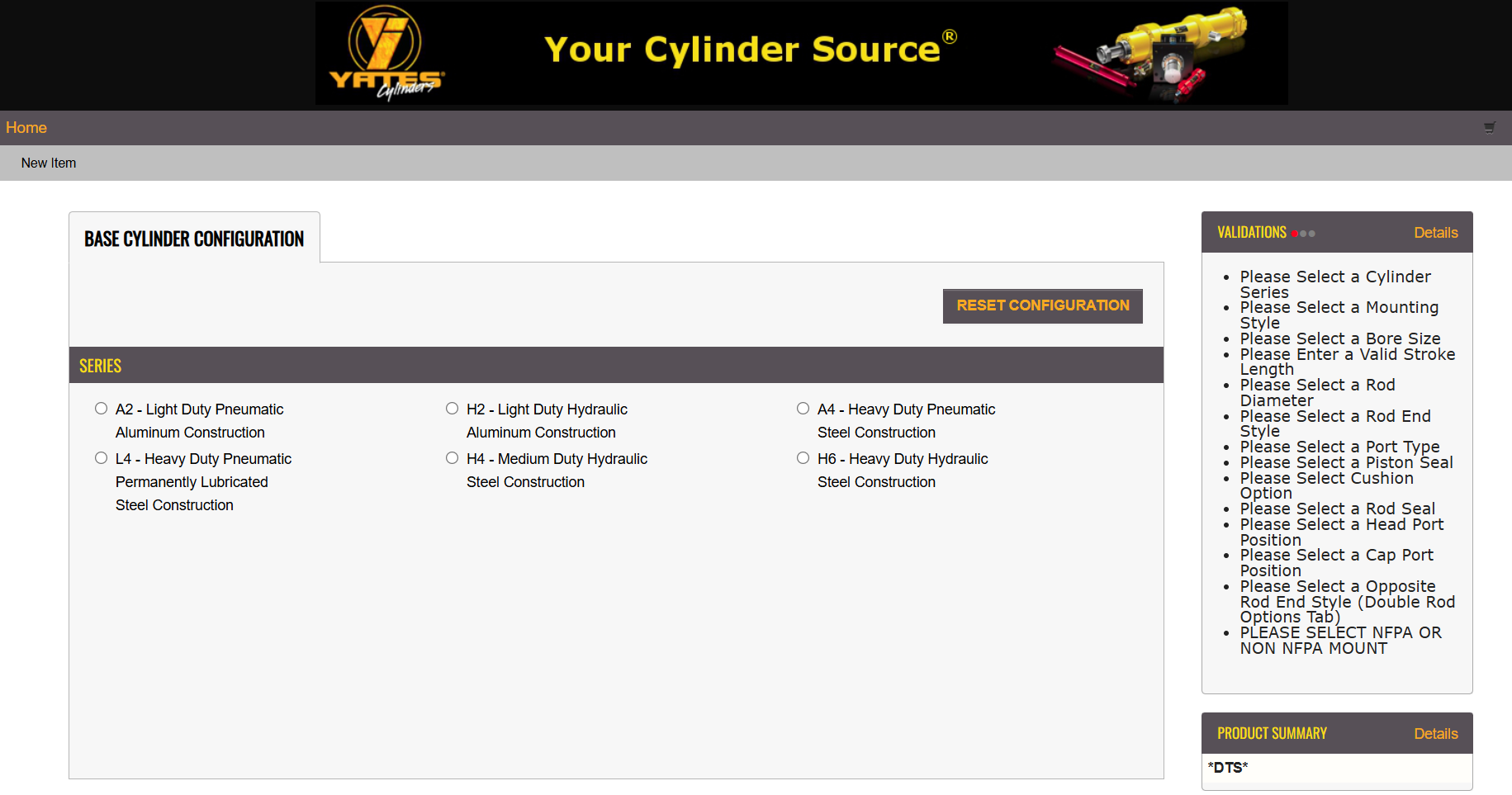
Ordering a custom tie rod cylinder can involve a lot of specifications—but it doesn’t have to be complicated. With so many options to consider, it can be difficult to know exactly what information you need or where to start. That’s why Yates Industries created an easy-to-use, easily accessible Tie Rod Cylinder Product Configurator to simplify the process.
Available directly through our website at www.yatesind.com, the configurator walks you through the cylinder-building process step by step. From selecting your cylinder series and bore size to choosing your stroke, rod diameter, mounting style, ports, seals, and other options, you can build a cylinder configuration based on the needs of your specific application.
You don’t have to figure everything out at once. The configurator guides you through each step and provides additional information along the way to help you make informed selections. And once you’ve completed your configuration and submitted your summary, our team of experienced engineers will review it and follow up if any additional information is needed.
Here’s how the Yates Tie Rod Cylinder Product Configurator works.
Step 1. Choose Your Cylinder Series
Start by selecting the cylinder series that best fits your application.
The configurator includes several options:
Not sure which series is right for you? You can hover over the available options in the configurator for additional information about things like pressure ratings, bore sizes, mounting styles, and operating temperatures.
Step 2. Select Your Mounting Style
Next, choose how the cylinder will mount to your equipment.
Available mounting styles include:
- Side lugs
- Pivot mounts
- Flange mounts
- Trunnion mounts
- Tie rod mounts
The right mounting style depends on how the cylinder will be installed and how it needs to move within your application.
Step 3. Choose Your Mounting Configuration
The configurator then lets you select how the tie rods are configured.
Options include:
- K: No Mount (MX0)
- L: Both tie rod ends extended (MX1)
- M: Head tie rods extended (MX3)
- N: Cap tie rods extended (MX2)
Step 4. Select the Bore Size and Stroke
Now it’s time to enter the basic dimensions of your cylinder.
Choose a bore size from 1½” to 8″, then enter the required stroke length in inches.
Once you enter the stroke length, press Enter to continue.
Step 5. Choose the Rod Diameter
Next, select the rod diameter that fits your application.
The available options include:
- 1″ rod diameter
- 1 3/8″ rod diameter
Step 6. Calculate Push and Pull Force
Need to know how much force your cylinder can produce?
The configurator includes a maximum push/pull force calculator. Select the calculator option and enter your required PSI to see the available force based on your cylinder configuration.
This can be especially helpful when determining whether a cylinder will provide enough force for your application.
Step 7. Select the Rod Type
Choose whether your cylinder will use a standard single rod or a double rod.
- S: Single rod (standard)
- D: Double rod
Step 8. Choose Your Rod End
The configurator gives you several rod-end options, including standard, extended, threaded, and specialty configurations.
Options include:
- Intermediate male
- Standard male
- Long female
- Standard female
- Extended standard male
- Plain end
- Male full thread
- Male rod coupling
- Special male rod end
- Special female rod end
- Special studded rod end
- Other/specified rod end
If your application requires something outside of the standard options, you can specify a custom rod end.
Step 9. Select Your Ports
Choose the type of ports required for your cylinder:
- N: NPTF ports
- S: SAE ports
- X: Other/specify
You will also be able to select the head and cap port positions based on how the cylinder will connect to your system.
Step 10. Select the Cushion
A cushion helps control the cylinder as it approaches the end of its stroke.
Choose from:
- N: Non-cushioned
- C: Cap cushioned
- R: Rod end cushioned
- B: Both ends cushioned
Unless you specify otherwise, the cushion location is determined by the factory.
Step 11. Choose Your Seals
The configurator allows you to select the seals that best fit your application.
Piston Seals
Options include:
- Nitrile U-cup
- Poly seals
- Viton seals
- Viton poly
- Cast iron rings
- High-load nitrile seals
- High-load viton seals
- Other/specify
Rod Seals
Options include:
- Hythane twin-lip hydraulic rod seal
- Poly seals
- Viton poly
- Other/specify
The right seal material can depend on factors such as the fluid being used, operating temperature, and application requirements.
Step 12. Select Port Positions
Next, select the desired head and cap port positions.
The configurator provides multiple position options so you can match the cylinder to the layout of your equipment.
Step 13. Review Maximum Operating Pressure
Before moving on, review the maximum operating pressure for your selected configuration.
It’s important to make sure your cylinder is properly matched to the pressure requirements of your hydraulic or pneumatic system.
Step 14. Add Cylinder Specials
Need something beyond the standard cylinder configuration?
The Cylinder Specials section allows you to add more specialized options, including:
- Single-acting cylinder configurations
- Flush plug ports
- Metallic rod wipers
- Set-screw pistons
- Wrench flats or spanner holes
- Drain-back glands
- Extended piston rods
- Stainless steel rod options
- Tie rod extensions
- Chrome-plated bores
- Additional port positions
- Air bleeders
- Stop tubes
- Special labeling, tagging, etching, or stenciling
- Air service
- Special shipping requirements
- Additional material or labor requirements
- Quality inspection or certification requirements
These options give you additional flexibility when your application requires a more specialized cylinder.
Step 15. Review Your Configuration
Once you’ve selected all of your options, you can proceed to the summary.
The summary gives you an opportunity to review your selections before moving forward.
This is where you can make sure your cylinder specifications match your application and any special requirements.
Step 16. Let Our Team Handle the Rest
Once you’ve completed your configuration and submitted your summary, you’re not on your own. One of our highly skilled engineers at our Michigan facility will review your cylinder specifications and make sure we have everything needed to move forward.
Our Michigan location specializes in tie rod cylinders, so our team understands the details that go into building a cylinder for your specific application. If we need any additional information or clarification, we’ll be in touch with you directly.
From configuration to final review, Yates is here to help make sure you get the right cylinder for the job.
Still not sure where to get started? No problem. Contact our team for more information.
Frequently Asked Questions
The configurator will guide you through the required specifications. Depending on your application, you may need to know your desired cylinder series, bore size, stroke length, rod diameter, mounting style, operating pressure, rod type, port type, cushion requirements, and seal preferences.
Can I customize my tie rod cylinder?
Yes. The configurator offers a wide range of standard and specialized options so you can build a cylinder around your application. These include different mounting styles, rod ends, ports, cushions, seals, port positions, stainless steel rod options, chrome-plated bores, air bleeders, stop tubes, and other cylinder specials.
What if I need a cylinder option that isn’t listed in the configurator?
If you need a specialized option that isn’t included in the standard selections, the configurator provides options to specify additional requirements. You can also provide special instructions for items such as rod ends, ports, labeling, shipping, materials, and quality requirements.
What happens after I submit my cylinder configuration?
Once you submit your configuration summary, the Yates team takes it from there. One of our highly skilled engineers at our Michigan facility, where we specialize in tie rod cylinders, will review your specifications. If additional information or clarification is needed, a member of our team will contact you before moving forward.
Does Yates manufacture custom tie rod cylinders?
Yes. Yates Industries manufactures custom hydraulic and pneumatic tie rod cylinders along with a variety of other cylinder solutions. Our team can work with your specifications to develop a cylinder that meets the requirements of your equipment and application.
Related Blogs
- Custom Hydraulic Cylinders: How to Customize a Cylinder for Your Application
- New Yates Industries 7-Day Mobile Cylinder Lead Time
- Double-Acting vs Single-Acting Hydraulic Cylinders: What to Know
- Inside Yates’ Hydraulic Cylinder Repair Process
- What Causes Hydraulic Cylinder Drift? Common Causes, Troubleshooting, and Prevention