How to Measure for a Replacement Hydraulic Cylinder
Replacing your hydraulic cylinder isn’t always as simple as measuring the bore or stroke. If you’re working with an older cylinder without a clear part number, getting accurate measurement...
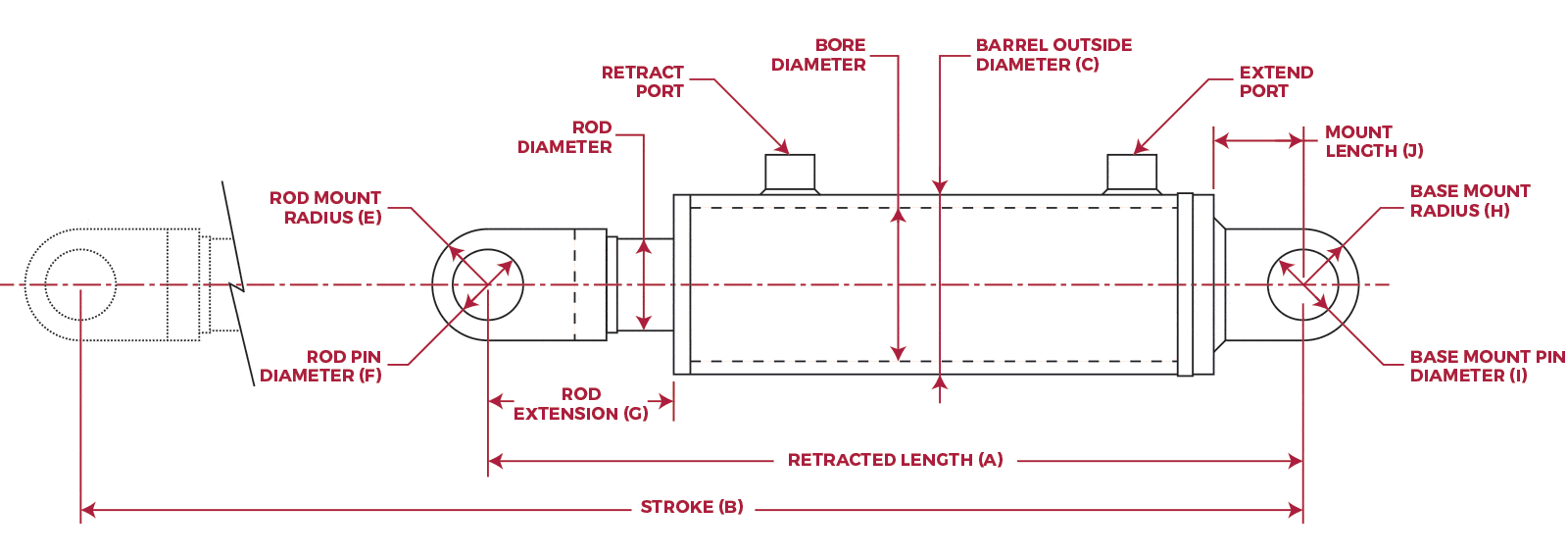
Replacing your hydraulic cylinder isn’t always as simple as measuring the bore or stroke. If you’re working with an older cylinder without a clear part number, getting accurate measurements and information can help identify the right replacement.
The good news? You don’t need to figure it all out on your own.
At Yates Industries, our team can measure, identify, and reverse engineer an existing cylinder to determine the specifications needed for a replacement. If the original cylinder is obsolete or no longer available, we can also design and manufacture a custom replacement.
This step-by-step guide explains what to look for and what measurements can be helpful when replacing a hydraulic cylinder.
Before taking measurements, identify the type of hydraulic cylinder you’re working with. The cylinder construction and design can affect the measurements and specifications needed for a replacement.
Common types include tie rod cylinders, welded cylinders, and mill duty cylinders. Identifying the cylinder type can help narrow down your replacement options and determine which dimensions are most important.
If the cylinder has a manufacturer name, part number, or other identification markings, record that information before moving on to the measurements.
Don’t have a part number or aren’t sure what type of cylinder you have? That’s okay. Photos of the cylinder can also give our team useful information when identifying an existing cylinder.
The cylinder bore is the inside diameter of the cylinder barrel. Bore size is one of the most important dimensions. It directly affects how much force the cylinder can produce.
If you disassemble the cylinder, measure the barrels inside diameter with a precision measuring tool. If the cylinder is still assembled, you may need documentation, a part number, or measurements of the other cylinder components to help determine the bore.
Don’t assume the bore size is based solely on the outside diameter of the barrel. Wall thickness can vary depending on the cylinder design and application.
If measuring the bore isn’t practical, don’t worry. Yates can measure the existing cylinder during evaluation and use that information to determine the specifications for a replacement.
Next, you will need to measure the diameter of the piston rod.
You can use a caliper to measure the rod’s diameter. Be sure to measure an undamaged area of the rod.
Avoid areas with scoring, corrosion, or wear from use.
Measuring the rod diameter is important. It helps match the replacement cylinder to the existing application. It also helps determine the cylinder’s strength and load capacity.
If the rod has damage, note the damage and provide photos if possible. You may need to replace a damaged rod rather than reuse it.
You don’t necessarily need to have every measurement before contacting Yates. If you can provide the cylinder or clear photos and the measurements you do have, our team can help determine the rest.
The stroke is the exact distance the piston rod travels between its fully retracted and fully extended positions.
To determine the stroke of your existing cylinder, measure the distance the rod travels from one position to the other. If the cylinder cannot be cycled, look for an original part number, drawing, machine specification, or any other specifications that may help identify the stroke.
Getting the stroke correct is critical when replacing a cylinder in an existing machine. The replacement needs to provide the required movement without interfering with the surrounding components.
If you aren’t able to determine the exact stroke, that’s another measurement our team can help identify.
As you may know, the retracted length is the overall length of the cylinder when it’s fully retracted.
Measure between the cylinder mounting points, taking the mounting style into account. Depending on the cylinder configuration, this could mean measuring from pin center to pin center or between other defined mounting surfaces.
This measurement is especially important when working in a confined space. A replacement cylinder can have the correct bore and stroke but still fail to fit because its retracted length or mounting dimensions are different.
Take a close look at how the cylinder attaches to the equipment.
Common hydraulic cylinder mounts include:
Measure the mounting dimensions that determine how the cylinder fits into the machine. Depending on the mounting style, this may include pin diameter, mounting width, hole spacing, flange dimensions, or eye dimensions.
When in doubt, take clear photos of both ends of the cylinder. Photos can be extremely helpful when identifying an existing mounting configuration.
Mounting dimensions are particularly important when reverse engineering a cylinder because the replacement needs to fit the existing equipment correctly.
View our cylinder accesories here.
The rod end is another dimension that can easily be overlooked when ordering a replacement.
Record the type and dimensions of the rod end, including:
If the cylinder connects directly to another component, the replacement rod end must fit that connection.
Measure and document the cylinder’s hydraulic ports.
Record:
Take note of whether the ports are positioned on the side of the barrel, near the end cap, or in another location.
Port setup is very important when space is limited. It also helps when existing hydraulic hoses cannot be easily rerouted.
Dimensions aren’t the only information needed to select a replacement hydraulic cylinder.
If possible, determine the system’s operating pressure and maximum pressure. Design the replacement cylinder to safely handle the demands of the application.
Also consider how frequently the cylinder operates and whether it experiences shock loads, high-cycle operation, extreme temperatures, corrosive environments, or other demanding conditions.
A cylinder that physically fits the machine isn’t necessarily the right cylinder for the application.
If you’re not sure of the operating pressure or other application specifications, provide Yates with as much information about the machine and its operation as possible. Our team can use that information when evaluating the cylinder.
Before replacing a cylinder, take a step back and look at the application.
Ask:
This information can help decide if the replacement should match the current cylinder exactly. It can also show if a different design would work better for the application.
The more information you can provide about the application, the easier it is for our team to determine the right cylinder for the job.
If you’re gathering information for a replacement cylinder, here’s a quick checklist to keep on hand:
Having this information readily available can save time when requesting a replacement or repair.
This can be worked around, even if you can’t easily measure every cylinder while it’s installed, and older cylinders may lack readable identification numbers.
Start with the measurements you can get and take clear photos of the cylinder, mounts, rod end, ports, and any identifying markings. Information about the machine and the cylinder application can also help.
If you’re dealing with an obsolete or hard-to-identify cylinder, a hydraulic cylinder manufacturer or repair facility may be able to evaluate the existing cylinder and determine the specifications needed for a replacement.
In some cases, technicians can repair or rebuild the existing cylinder instead of replacing it. In other cases, reverse engineering or a custom replacement may be the better option.
A damaged cylinder doesn’t automatically require replacement.
If the barrel, rod, mounts, and other main parts are in good condition, rebuilding the cylinder may be practical. A rebuild can involve replacing seals and other worn components while restoring the cylinder to working condition.
Replacing the cylinder may make more sense when it is badly damaged, obsolete, or no longer meets the application’s needs. It may also make sense when repair would cost more than replacement.
The best option depends on the cylinder’s condition, the application, repair costs, lead time, and replacement part availability.
Getting the measurements right is an important part of replacing a hydraulic cylinder, but you don’t have to do all of the measuring and identification yourself.
Yates Industries manufactures and repairs hydraulic and pneumatic cylinders for a wide range of industrial applications. When you have a cylinder that needs to be replaced, repaired, rebuilt, or reverse engineered, our team can help determine what you need.
Have an old, damaged, or hard-to-identify cylinder? Send us the information you have, and we’ll take it from there. Our team can measure the existing cylinder, reverse engineer the design, and manufacture a replacement built for your application.
You provide the cylinder and the details you have. We’ll handle everything else.